
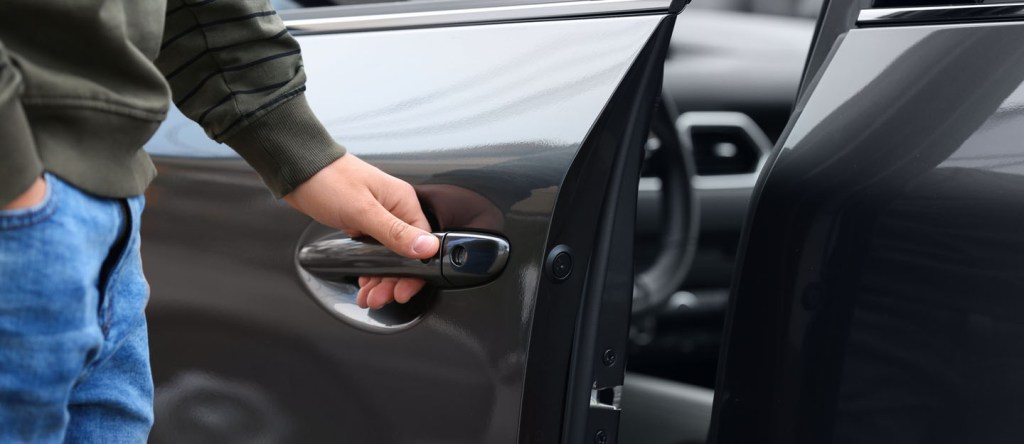
(Organised Summary of Requirements)
1. Exterior Door Handle Requirements
(Tailgate excluded)
1.1 Mechanical exterior handles
- Every door must be equipped with a mechanical exterior door handle, except the tailgate.
- After a collision or traction battery fire, the door must be openable via the exterior handle without using tools.
- ⚠️ Note:
- Earlier drafts limited this requirement to the non-impact side door.
- This limitation has been removed in the approval draft.
1.2 Minimum hand operating space
- In any state, the exterior door handle must provide a minimum hand access space relative to the vehicle body surface of:
- 60 mm × 20 mm × 25 mm
- ➜ This prohibits fully hidden / fully flush exterior door handles with no accessible hand clearance.
2. Interior Door Handle Requirements
(Tailgate excluded)
2.1 Mechanical interior handles
- Every door must be equipped with a mechanical interior door handle.
- If an electrical interior door handle is used, a mechanical emergency interior handle must also be provided.
2.2 Emergency opening capability test
Under the following conditions, the door must be openable using the mechanical interior handle:
- Vehicle is stationary and locked
- Child lock is not engaged
- Power to the door handle system is disconnected
(excluding backup power, supercapacitors, or redundant supplies) - Power to:
- the traction battery, and
- the low-voltage auxiliary battery system
is disconnected
- ⚠️ Approval draft change:
- Explicitly requires disconnection of the traction battery, tightening the requirement.
2.3 Installation position of mechanical interior handles
- The mechanical interior handle must be installed:
- On the door itself, or
- Within 300 mm of the door edge
- Vertical position requirements:
- Handle’s vertical center must be within 0–680 mm above the seat R-point
- No interior components may obstruct access to the handle
- ⚠️ Approval draft clarification:
- Adds the “vertical center position” definition, improving design verification accuracy.
2.4 Multiple mechanical interior handles
- If a door is equipped with multiple mechanical interior handles:
- Any single handle must independently open the door
- Handles must not rely on a shared actuation path
2.5 Identification and marking
- Mechanical and electrical interior handles must have a visible identification mark of at least:
- 10 mm × 7 mm
- Mechanical interior handles must also include:
- Opening method instructions
- Text (Chinese) or pictogram with a minimum height of 6 mm
- Exemptions:
- Straight pull-type handles
- Ring-type handles
- Markings must:
- Not be obscured
- Be clearly distinguishable from the background
- Be permanently visible
- Remain legible in low-light conditions
(e.g. backlighting, fluorescence, external illumination)
- ⚠️ Approval draft change:
- Adds explicit pictogram size requirements.
3. Owner’s Manual Requirements
- The vehicle user manual must include:
- Door handle locations
- Operating instructions
- Special usage instructions for emergency or abnormal situations
4. Electrically Released Door Safety Requirements
(Tailgate excluded)
4.1 Functional suppression after restraint deployment
- When an irreversible restraint system (e.g. airbags) is deployed:
- Electrically released door handles should be functionally suppressed to prevent unintended door opening
- ⚠️ Draft evolution:
- Earlier drafts mandated a minimum 5-second suppression.
- Approval draft removes the fixed 5 s requirement, allowing manufacturers to define their own strategy.
- This point remains one of the most controversial changes.
4.2 Mechanical release after power loss
- After power loss, the door must still be openable via the mechanical release of the exterior handle.
Test preconditions:
- Door lock fully engaged
- Locking mechanism in locked state
- Traction battery disconnected (if equipped)
Verification methods (one of two):
a) Static test
- Trigger irreversible restraint deployment
- Disconnect power within 70 ms ± tolerance
- If multiple door-lock power sources exist in different areas, disconnect one
- After 1 minute, disconnect remaining low-voltage auxiliary batteries
- Operate the mechanical exterior handle
- Door must be openable within 5 minutes
b) Dynamic test
- Conduct frontal sled crash test
- Inject simulated crash signal at 30 ms
- Disconnect power at 100 ms
- Same battery disconnection logic as static test
- After 1 minute, disconnect remaining low-voltage batteries
- Door must be openable via mechanical exterior handle within 5 minutes
- ⚠️ Approval draft change:
- Explicit requirement to disconnect the traction battery first, then other low-voltage batteries after 1 minute.
- This significantly impacts technical architecture choices.
5. Door Handle Strength Requirements
Door handles must withstand applied forces without structural damage or detachment and still allow door opening:
5.1 Exterior door handles
- Apply 500 N
- Maintain force for at least 5 seconds
5.2 Interior door handles
- Non-electronic button type:
- 200 N, at least 5 seconds
- Electronic button type:
- 50 N, at least 5 seconds
 Parallel Drive
Leave a comment