
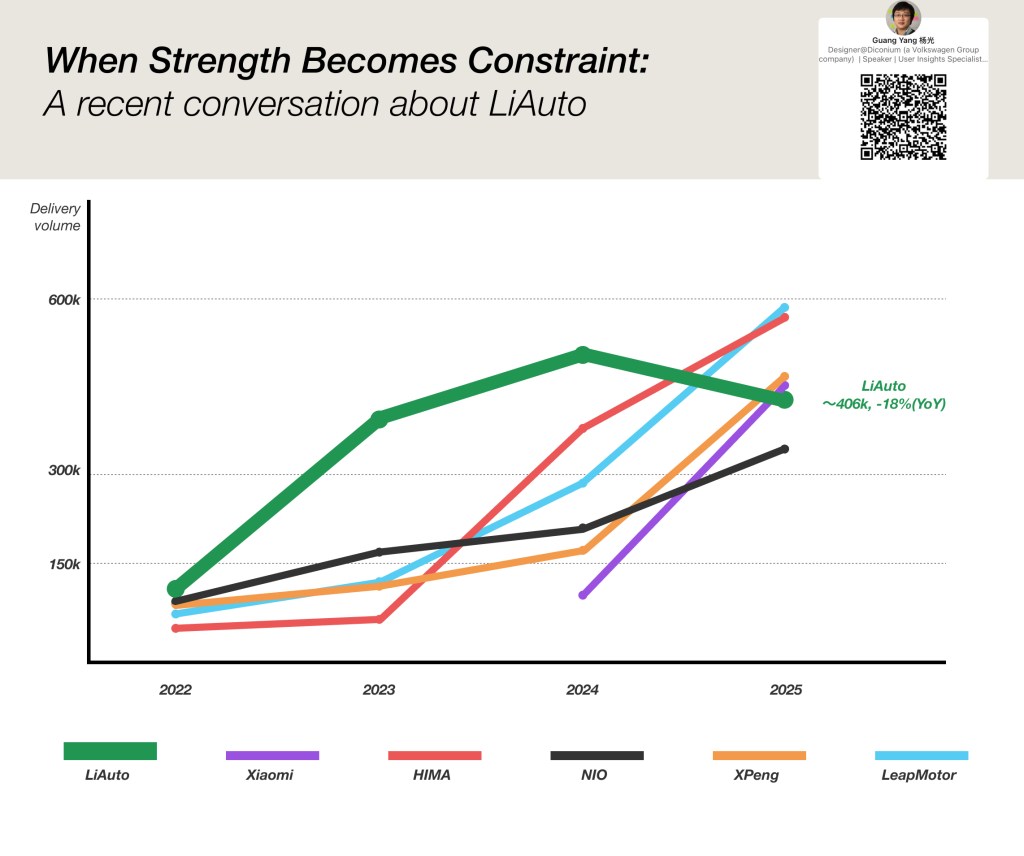
This thought came from a recent conversation with a friend affiliated with LiAuto. We discussed the recent release of Li Auto’s financial report — where key indicators such as revenue, deliveries, and profit are all trending downward.
Li Auto was once one of the smartest players in China’s NEV market — clearly targeting family users, using REEV to solve range anxiety, and delivering features that truly matched everyday needs. That sharp positioning made it both successful and profitable.
But in business, there is no permanent comfort zone. Li Auto’s success was, in many ways, tied to a specific phase — when batteries were expensive and charging infrastructure was still limited. By 2025, that foundation had shifted.
As the market evolved and competition intensified, the advantages of REEV narrowed. At the same time, user expectations moved forward. Some product decisions began to feel less grounded in real, immediate needs.
What stands out is this: The very strength that once defined success can quietly become a constraint.
In a fast-moving market like China, past formulas expire quickly. Staying relevant requires continuously re-aligning with real users — their behaviors, priorities, and pain points. So the question is: When the market moves on, can we brave enough to let go of what once made us successful?
hashtag#Automotive hashtag#ChinaEV hashtag#ProductStrategy hashtag#UserExperience hashtag#DesignThinking hashtag#Mobility hashtag#Business
 Parallel Drive
Leave a comment